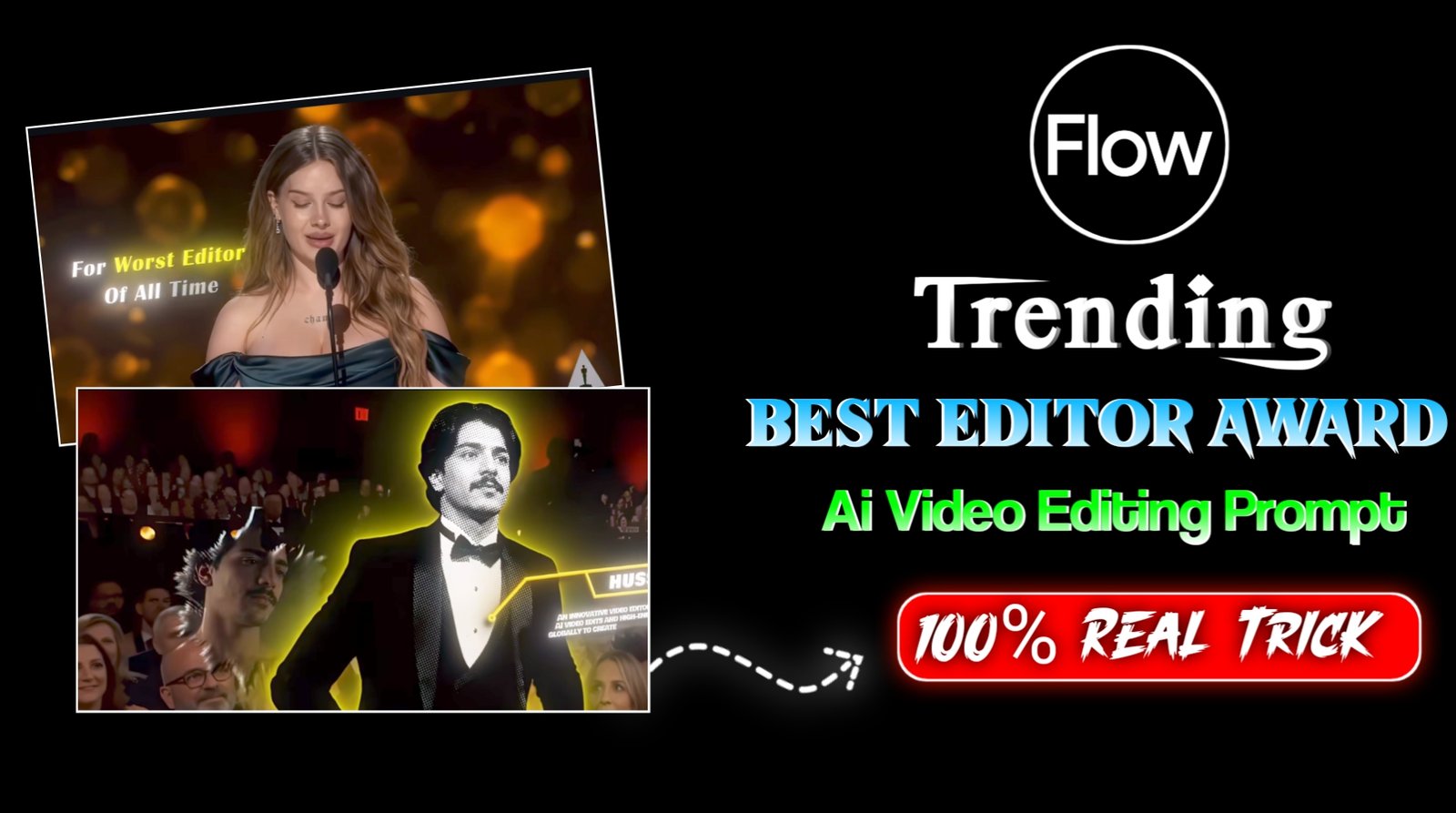
If you are active on social media right now, you must have noticed that a “Best Editor Award” style video editing trend is going viral on Instagram. Almost every video editor, reels editor, and content creator is making these types of videos and posting them on their social media platforms. Because of this trend, their reels are getting millions of views and hundreds of thousands of likes. You can create this video by using your own photo along with a girl’s photo. If you only want to show your own photo, you can do that as well. Or, if you want to include the image of a girl calling you, you can upload her image too. This makes the final video look much more attractive and gives it a highly professional, well-edited appearance. So, if you also want to create this type of video, then in today’s article I am going to show you the complete process and all the simple steps required to make it. Just make sure to read this article carefully from beginning to end. So let’s get started!
Best Editor Award AI Reel Editing – Complete Free Guide
So guys, if we talk about the details of this viral Best Editor Award video editing trend, you already know that nowadays there are many editors who edit all kinds of videos and consider themselves editors. Even people who are not professional editors also like creating this type of video because everyone believes they are a great editor and can edit different kinds of videos. That’s why they also want to create this Best Editor Award style video. The main reason behind this trend is that these videos are going viral on Instagram. So, you can also create this type of video, which looks very attractive and highly realistic. In this article, we are going to explain the complete process step by step. The best part is that the entire method is completely free, and you can easily create this type of video by using Flow AI.
Note :- First, upload your reference image. Then upload the second character
reference image of the person you want to appear with in the video.
Use the uploaded portrait only as the facial identity reference for
Character 2 (VM Editor). Preserve the exact facial geometry, facial proportions, jawline, cheekbone
structure, eyebrow shape and density, eye spacing, eye shape, nose structure, lips, hairstyle,
hairline, skin tone, facial texture, and overall facial identity with absolute consistency throughout
every shot. Maintain complete identity lock from the opening frame until the final frame so the
character remains instantly recognizable without facial drift, morphing, or inconsistencies.
The presenter is a completely original female character and should remain visually consistent
throughout the sequence.
Character 1 — Presenter
The presenter is an elegant Caucasian woman approximately twenty-five to thirty years old with
a slim, athletic build and balanced body proportions. She has a fair complexion with neutral
undertones and ultra-photorealistic skin rendering. Her skin features subtle micro-pores, delicate
epidermal texture, realistic subsurface scattering beneath stage lighting, a satin-matte finish,
and natural specular highlights across the forehead, cheekbones, nose bridge, and lips.
Her face is oval-shaped with a defined jawline, softly sculpted cheekbones, expressive
almond-shaped blue eyes, naturally full eyebrows, a straight slender nose, and naturally full lips
finished with soft pink lipstick. Her long blonde hair is styled in voluminous layered waves with a
graceful side part that catches the warm rim light from the stage.
She wears small silver diamond stud earrings and delicate minimalist rings.
Her outfit is a premium sleeveless evening gown featuring a high mock-neck collar. The dress is
constructed from dense cobalt-blue sequin fabric that produces physically accurate light
reflections under professional stage spotlights. Every sequin responds naturally to movement,
creating elegant shimmering highlights without appearing exaggerated. The gown fits closely to
the body with perfectly tailored seams and realistic fabric behavior around the shoulders, waist,
and torso.Throughout the sequence she maintains confident posture, relaxed shoulders, graceful hand
gestures, a warm charismatic smile, and polished stage presence. She confidently holds a
black winner announcement card while standing behind the podium.
Character 2 — VM Editor
Use the uploaded portrait as the exclusive facial identity reference.
Azhan is a young South Asian male approximately twenty to twenty-five years old with an
average height, lean physique, and balanced proportions. His complexion is medium tan with
realistic warm undertones. His skin contains natural micro-pores across the cheeks and nose,
realistic facial texture, subtle beard shadow along the jawline, hydrated lips with fine vertical
creases, and physically accurate subsurface scattering beneath the theater lighting.
His face features a square-oval shape with sharp masculine facial structure, defined jawline,
high cheekbones, dark almond-shaped eyes, naturally thick eyebrows, and short textured black
hair styled upward with faded sides. He wears clean black rectangular eyeglasses that produce
subtle realistic lens reflections without obscuring the eyes.
He wears a structured tailored evening suit consisting of a medium-grey matte wool-blend
blazer with classic notched lapels and a single-button front closure. Beneath the blazer is a
charcoal-grey tailored vest layered over a matching dark grey dress shirt. The garments display
premium tailoring, crisp stitching, physically accurate cloth simulation, natural compression
folds around the shoulders, elbows, and waist, and realistic fabric movement as he stands and
buttons the blazer.
At the beginning of the sequence he appears tense and emotionally uncertain. After hearing his
name announced, his expression naturally transitions into disbelief, surprise, emotional relief,
pride, and quiet confidence before standing up smoothly.
Environment
Stage
The ceremony takes place inside a luxurious modern awards venue inspired by prestigious
international film award ceremonies while remaining entirely original.
The stage features a deep matte black backdrop decorated with large soft golden cinematic
bokeh lights that remain beautifully blurred throughout the sequence.
A large abstract golden award sculpture stands behind the presenter as a decorative
centerpiece. The sculpture is completely original and does not resemble any existing award
statue.The presenter stands behind a crystal-clear acrylic podium fitted with a slim black
gooseneck microphone.
She holds a premium matte-black winner announcement envelope and matching announcement
card.
The atmosphere feels elegant, prestigious, luxurious, and cinematic.
Auditorium
The audience occupies a grand theater featuring multiple rows of plush dark red velvet seats
separated by polished dark wooden armrests.
Hundreds of well-dressed attendees fill the auditorium wearing tuxedos, black suits, elegant
gowns, and formal evening attire.
The audience remains softly blurred due to the shallow depth of field while still appearing lively
and realistic.
Warm ambient lighting creates an intimate cinematic atmosphere while a dedicated white
spotlight softly isolates Azhan from the surrounding crowd.
Camera Setup
Capture the sequence in cinematic 16:9 widescreen.
Native 4K UHD resolution.
24 fps.
180-degree shutter.
Professional digital cinema camera aesthetic.
Stage shots use approximately a 50mm anamorphic cinema lens with shallow depth of field
producing elegant golden oval bokeh.
Audience shots use approximately an 85mm telephoto cinema lens with shallow depth of field,
creating beautiful compression while separating Azhan from the audience.
Focus remains perfectly locked on the active speaker or subject throughout each shot.
Camera movement remains extremely subtle, resembling professional stabilized broadcast
cinematography.
Lighting
Stage Lighting
Illuminate the presenter using professional three-point stage lighting.
A powerful cool-white key light positioned front-left softly illuminates her face.
A gentle fill light from camera-right preserves shadow detail while maintaining cinematic
contrast.A warm golden rim light separates her hair and shoulders from the background while visually
matching the glowing award sculpture.
The blue sequined gown produces elegant sparkling reflections as she naturally moves.
Audience Lighting
The theater is illuminated with warm tungsten ambient lighting.
A dedicated soft white spotlight naturally isolates Azhan while maintaining realistic falloff into
the surrounding audience.
Subtle reflections appear across his glasses, skin, and blazer without distracting from the
performance.
Scene 1 — Presenter (00:00–00:03)
The sequence opens with a perfectly centered medium close-up of the presenter standing
behind the transparent podium.
She lowers her eyes toward the announcement card before slowly raising her gaze toward the
audience.
She smiles politely while maintaining elegant posture.
Her lips move naturally with perfectly synchronized speech as she says:
“And the award for worst editor of all time goes to…
”
Her tone is dramatic, playful, and suspenseful.
The camera remains completely static while the golden background lights softly shimmer out of
focus behind her.
Scene 2 — Audience Reaction (00:03–00:04)
A hard cinematic cut transitions into a medium shot of VM Editor seated inside the theater.
He sits perfectly still.
His shoulders remain slightly tense.
His hands rest naturally.
His eyes stare toward the stage without blinking.
His facial muscles tighten slightly as anticipation builds.
The audience behind him remains softly blurred while quietly watching the stage.
Only subtle breathing and tiny eye movements are visible.
Scene 3 — Winner Announcement (00:04–00:05)
A hard cut returns to the presenter.
She opens into a broad smile while lifting the announcement card slightly.
She clearly and enthusiastically announces:”
…VM Editor!”
Her mouth animation matches the spoken dialogue perfectly.
The lighting continues to sparkle across the blue sequined dress while the golden award
sculpture glows softly behind her.
Scene 4 — Standing Ovation (00:05–00:09)
Immediately after hearing his name, Azhan freezes for a brief fraction of a second.
His expression transforms from disbelief into genuine surprise.
His eyes widen naturally.
A small emotional smile appears.
He quickly stands from the theater seat in one smooth, physically accurate movement.
As he rises, both hands naturally reach toward the front of his blazer.
He calmly fastens the single front button with practiced confidence.
The fabric folds naturally around the shoulders and waist during the movement.
Once fully standing, he turns toward the stage while maintaining an emotional yet composed
expression.
Behind him, the audience immediately erupts into enthusiastic applause.
People smile, clap naturally, and look toward him with admiration.
The camera performs a subtle upward tilt while remaining smoothly stabilized to maintain
perfect framing as he stands beneath the spotlight.
The final frame holds on Azhan confidently facing the stage while surrounded by applause.
Audio Design
Presenter (00:00–00:03): “And the award for worst editor of all time goes to…
”
Tone: Dramatic, suspenseful, confident.
Presenter (00:04–00:05): ”
…VM Editor!”
Tone: Loud, joyful, celebratory.
Audience (00:05–00:09):
A sudden burst of realistic applause fills the theater.
Natural cheering, clapping, seat movement, and subtle crowd ambience surround the room while
maintaining cinematic clarity.
No background music is present.
Only authentic theater ambience and applause.
Emotional Progression
The emotional journey begins with suspense and anticipation.It quickly shifts into nervous uncertainty as Azhan waits for the announcement.
The reveal creates genuine surprise followed by emotional validation.
The sequence concludes with confidence, pride, celebration, and recognition while maintaining
grounded realism rather than exaggerated performance.
Visual Style
Create a premium Hollywood-style cinematic awards ceremony with ultra-photorealistic
rendering, physically accurate human skin shading, realistic subsurface scattering, premium
cloth simulation, physically based lighting, authentic eye moisture, natural facial animation,
accurate lip synchronization, cinematic anamorphic optics, shallow depth of field, elegant
golden bokeh, restrained highlight bloom, subtle organic film grain, high dynamic range, realistic
crowd animation, premium production design, and polished feature-film quality.
The final result should feel like an original, high-budget international awards broadcast while
avoiding copyrighted event branding, logos, trademarks, recognizable award show names, or
other protected intellectual property.
Part 2
Generated video: Create a single ultra-photorealistic cinematic acceptance speech sequence in
true 16:9 landscape using ONLY the two uploaded reference images. The first uploaded image is
the mandatory identity reference for the main character. The second uploaded image is the
mandatory stage and lighting reference. Do not invent, redesign, beautify, stylize, or reinterpret
any visual element outside what is shown in these references. The finished result must feel like
genuine live television footage captured during a prestigious Hollywood-style awards ceremony
rather than AI-generated content.
The male character must preserve the exact identity shown in the uploaded reference image.
His face must remain perfectly consistent throughout the entire sequence with absolutely no
facial drift between shots. Preserve the exact forehead shape, face proportions, cheekbones,
jawline, chin, eyebrows, eyelashes, eye shape, iris color, nose bridge, nostrils, lips, ears, beard
shadow, skin tone, skin texture, pores, freckles, facial imperfections, neck proportions, shoulder
width, posture, body proportions, and every recognizable facial characteristic exactly as shown.
The hairstyle is extremely important and must never change. Preserve the identical taper fade
haircut from the uploaded reference, including the exact fade height, hairline shape, fringedirection, hair density, natural texture, hair thickness, hair volume, and dark hair color. Never
generate fluffy hair, longer curls, messy hair, side-part hairstyles, or any hairstyle that differs
from the uploaded reference. The taper fade remains identical throughout every frame.
The wardrobe should remain elegant and realistic. The character wears a perfectly tailored
charcoal-grey single-breasted suit jacket over a crisp white dress shirt with a matte charcoal
slim necktie. Preserve realistic cloth simulation including natural shoulder folds, sleeve wrinkles,
chest tension, subtle movement around the elbows, accurate collar shape, and physically
believable fabric behavior. His round thin-frame glasses must remain identical to the reference
with realistic metallic reflections, subtle lens distortion, proper transparency, and accurate eye
visibility through the lenses.
The entire environment must closely match the uploaded stage reference. Build a luxurious
Hollywood-inspired awards ceremony stage featuring the same elegant visual style shown in the
reference image. A polished wooden podium stands centered on stage with two slim
professional black gooseneck microphones mounted naturally on top. Behind the podium is a
deep black background featuring oversized golden abstract award-statue silhouettes
surrounded by warm amber cinematic bokeh circles exactly matching the uploaded stage
reference. The stage lighting should recreate the same premium atmosphere with soft golden
highlights, cinematic contrast, deep blacks, realistic reflections, and elegant HDR exposure.
Avoid adding unnecessary decorations, screens, banners, logos, graphics, or visual clutter.
Beyond the stage sits a completely full theater audience inside a luxurious auditorium. Every
visible chair must be occupied by formally dressed guests wearing tuxedos, elegant suits, and
evening gowns. Absolutely no empty seats should appear anywhere in the frame. The audience
must feel naturally diverse while remaining photorealistic and premium in appearance. Every
person should have realistic facial anatomy, visible pores, believable skin texture, natural
wrinkles, authentic eye reflections, subtle facial asymmetry, accurate subsurface scattering,
realistic hair strands, and unique facial identities. Avoid duplicated faces, repeated hairstyles,
plastic skin, oversharpening, AI artifacts, or unrealistic beauty filtering. The audience behaves
naturally with realistic breathing, blinking, gentle applause, tiny posture adjustments, and subtle
expressions while remaining focused on the speaker.The sequence begins with a smooth stabilized cinematic tracking shot following the main
character as he confidently walks toward the podium while holding a gold Oscar-style
statuette naturally with both hands. His eyes remain slightly lowered with a modest smile as he
approaches center stage. His breathing is calm and natural while the audience applauds politely
in the background. His fingers adjust around the gold statuette with anatomically correct hand
movement, realistic tendon motion, subtle finger pressure, and physically accurate grip. The
tracking shot gradually settles into a perfectly composed medium shot filmed using a 50mm
anamorphic lens with shallow depth of field. The audience behind him softly falls out of focus,
creating elegant oval bokeh while preserving the luxurious atmosphere.
As he arrives behind the podium, perform a subtle cinematic light-flash transition into a perfectly
centered medium close-up captured using an 85mm anamorphic cinema lens. The camera
becomes completely static, emphasizing intimacy and authenticity. The framing includes his
upper torso, both microphones, the upper section of the gold statuette, and the elegant golden
stage background. Warm theatrical lighting illuminates his face from a forty-five-degree angle
while a soft golden rim light separates his taper fade hairstyle and shoulders from the dark
background. His glasses display realistic reflections without hiding his eyes. Fine details such
as eyelashes, eye moisture, skin pores, beard shadow, peach fuzz, lip texture, and subtle facial
muscle movement remain clearly visible.
He slowly raises his head from the podium and makes direct eye contact with the audience
before looking gently toward the camera. A genuine humble smile naturally develops without
exaggeration. His facial performance relies on tiny muscle contractions, realistic blinking,
natural breathing, subtle jaw movement, and believable emotional warmth rather than theatrical
acting. Every expression should appear completely human and emotionally authentic.
He then speaks clearly into the microphones, saying,
“Thank you… thank you everyone.
” The
dialogue must feature perfectly synchronized lip movement, anatomically correct jaw
mechanics, natural tongue movement, realistic cheek deformation, subtle pauses, and authentic
breathing between words. His voice should sound warm, humble, confident, grateful, and
emotionally sincere without sounding overly dramatic. The audience responds with realistic
applause that gradually increases in volume while remaining natural and never overwhelming his
speech.Lighting throughout the sequence follows premium Hollywood broadcast standards. A soft
high-intensity cinematic key light positioned approximately forty-five degrees from camera left
produces beautiful facial modeling and crisp catchlights inside the eyes. Gentle fill lighting
preserves natural shadow detail while maintaining cinematic contrast. A warm rim light cleanly
separates the character from the background. Skin rendering must remain exceptionally realistic
with visible pores, natural oil variation, subtle vascular coloration around the cheeks and nose,
fine peach fuzz, accurate subsurface scattering along the ears and jawline, and believable
semi-matte skin reflectance. Avoid plastic skin, oversmoothing, artificial sharpening, CGI
appearance, exaggerated symmetry, or beauty-filter artifacts.
The cinematography should emulate a premium Hollywood awards broadcast captured using an
ARRI Alexa 35 or Sony VENICE 2 with anamorphic prime lenses. Use authentic depth
compression, realistic lens breathing, subtle horizontal anamorphic characteristics, elegant oval
bokeh, natural HDR highlight roll-off, premium cinematic color science, and fine organic film
grain. Motion blur should remain physically accurate at 24 frames per second. Camera
stabilization remains smooth and professional without unnecessary handheld shake or dramatic
movement.
Audio should consist entirely of authentic production sound recorded during a live awards
ceremony. Include realistic auditorium ambience, gentle audience movement, distant applause,
subtle room reflections, natural cloth movement, microphone resonance, quiet breathing, soft
podium interaction, and believable theatrical acoustics. Do not include orchestral music,
cinematic score, dramatic stingers, artificial sound effects, or exaggerated crowd reactions. The
atmosphere should feel identical to a genuine internationally televised awards ceremony.
Render the final sequence in native ultra-photorealistic 4K HDR with flawless continuity,
physically accurate cloth simulation, anatomically correct hands, premium facial animation,
realistic eye reflections, perfect identity preservation from the uploaded reference images,
seamless transitions, authentic Hollywood broadcast color grading, and true live-action realism
from beginning to end. Every frame should appear indistinguishable from footage captured by a
professional cinema camera during a real Academy Awards-style a
How to Make a Best Editor Award AI Video
To create this viral Best Editor Award video, I’m going to explain a few simple steps and the complete process. By following these steps, you can easily make this type of video without any difficulty To get started, I’ll first walk you through 4–5 simple steps. Make sure to read each one carefully.
- First, click on the Generate Video button above. After that, sign up using your Google account.
- Next, copy the prompt provided on the website.
- Then you have to upload your and the girl’s photo in flow ai
- Now you have to paste the prompt and keep the video size as 16.9
- As soon as you send it, the video will be ready, save it.
What Is The Flow Ai –
So friends, if you don’t know about Flow AI and are wondering what it actually is, let me explain it to you. Flow AI is an application by Google that allows you to generate different types of AI videos. For example, you can upload any type of photo, and with the help of a prompt, it can merge the images and convert them into a video. The type of prompt you write determines the kind of video it generates. You can also generate text-to-video content. Simply enter your text, and it will generate a video based on your description. This platform is very useful because it allows you to create different types of AI videos for free. You can easily generate around 4 to 5 videos per day using this website. It also lets you choose the video aspect ratio, such as 9:16 or 16:9. In addition, there are many other features available that you can use to generate AI videos.
Conclusion
In today’s article, I showed you a tutorial on how to create a viral Best Editing Award, Best Reels Editing Award, or any similar editing award video. By following this method, you can upload your own photos and generate this type of Best Editing Award video, which looks very attractive and highly professional. The final video does not look like it was generated by AI. Instead, it appears very realistic because the AI editing is done in such a high-quality way. I personally found the AI-generated editing to be very impressive. You can easily create these types of videos by following all the steps .